HMPE Slings
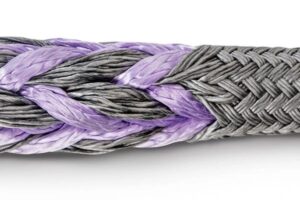
HMPE fiber slings represent a cutting-edge lifting solution, combining lightweight construction with exceptional strength and durability. Engineered from ultra high molecular weight polyethylene fibers, these slings are ideal for demanding lifting applications where performance, safety, and efficiency are paramount.
Key advantages of HMPE slings
High Strength-to-Weight Ratio: HMPE fibers provide unparalleled lifting capacity while remaining significantly lighter than traditional slings, reducing operator fatigue and easing transportation.
- Low Stretch: Minimal elongation under load ensures precision and stability during lifts.
- Exceptional Durability: Resistant to abrasion, UV exposure, chemicals, and moisture, HMPE slings perform reliably in harsh environments, including marine and offshore applications.
- Load Protection: The soft, yet strong, material reduces the risk of surface damage to delicate or high-value loads.
- Enhanced Safety: Lightweight construction reduces handling hazards, and the material’s strength minimizes the risk of sling failure under rated loads.
Commonly used in industries such as shipping, construction, aerospace, and heavy manufacturing, HMPE slings excel in critical applications requiring superior performance and reliability. Proper inspection, adherence to load limits, and compliance with safety standards are essential for ensuring safe and effective use.
HMPE Fiber vs Steel
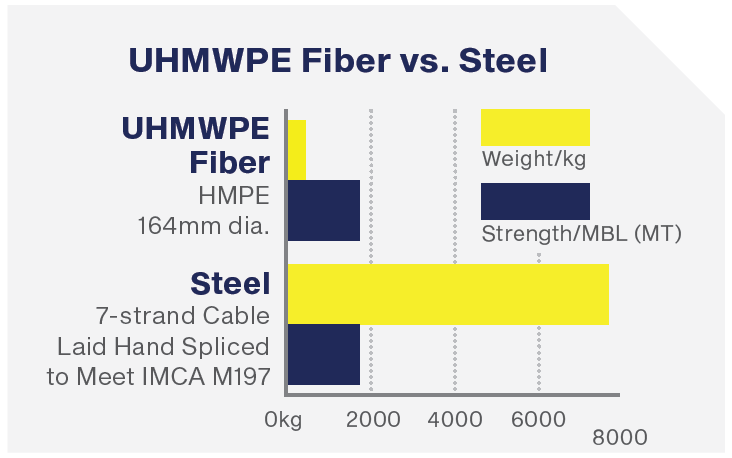
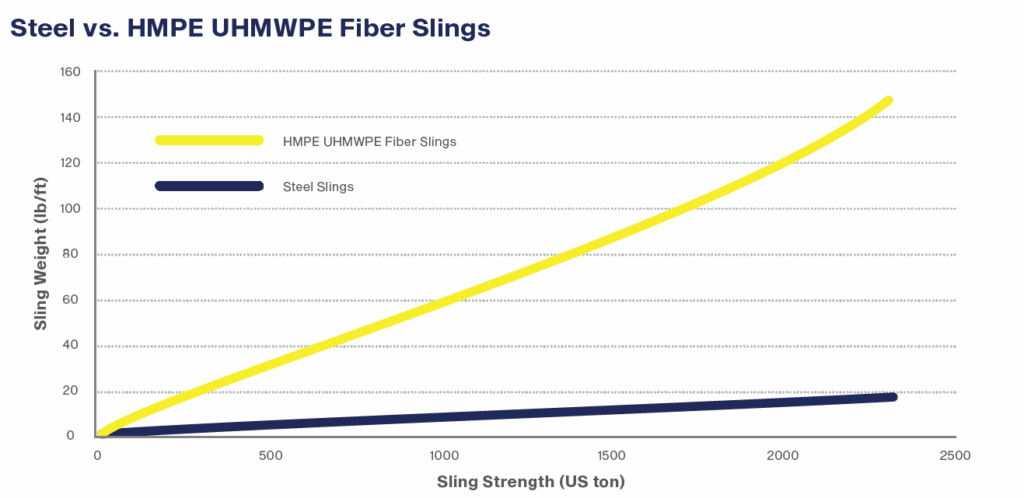
HMPE fiber ropes and slings have become increasingly popular as replacements for steel wire ropes in load handling. These modern, high-strength synthetic fibers offer remarkable durability without the risks of rust or corrosion. They remain unaffected by both salt and fresh water, and can be safeguarded against abrasion, cutting, and heat damage. Additionally, they are easy to inspect and repair.
- Weight Reduction: They are 1/7 the weight of comparable steel wire rope sling.
- Rigging Efficiency: The lightweight nature reduces rigging time.
- Ease of Handling: Their flexibility and softness make them easier and safer to handle.
- Cost Savings: Reduced handling, transportation, and storage costs.
- Repurposing: Splice into different lengths / configurations throughout life of the sling.
Benefits of HMPE Fiber vs. Steel
- Lighter and easier to handle
- Reduced risk of injury
- Remarkably durable, will not rust or corrode
- No broken/protruding wires
- Saves on transportation, storage, set-up
- Low maintenance
- Not affected by salt or freshwater
- Easy to inspect and splice
Physical Properties of HMPE
Creep
Creep refers to the irreversible elongation of a rope under constant loading. Ropes experiencing creep often maintain relatively high breaking strengths until they are on the verge of failure, highlighting the importance of monitoring operating conditions that could cause excessive creep. When used within the recommended working load limit (WLL) and temperature range, HMPE exhibits minimal creep elongation during normal operations.
The risk of a rope creeping can be simplified into “The Three Ts”: tension, temperature, and time. Any operating conditions involving high loads, elevated temperatures, or extended durations will increase the likelihood of elongation due to creep.
Abrasion Resistance
HMPE is renowned for its superior abrasion resistance compared to other fibers. This attribute is due to the molecular alignment of the polymer and the fiber’s low coefficient of friction. When braided into a rope, this property allows the fibers to move easily relative to one another, minimizing damage from abrasion.
Resistance to Chemical Emersion
| Chemical | 6 Mos. | 2 Yrs. |
|---|---|---|
| Seawater | Safe | Safe |
| Hydraulic Fluid | Safe | Safe |
| Kerosene | Safe | Safe |
| 10% Detergent Solution | Safe | Safe |
| Gasoline | Safe | Safe |
| Toluene | Safe | Moderate |
| Glacial Acetic Acid | Safe | Safe |
| 1M Hydrochloric Acid | Safe | Safe |
| 5M Sodium Hydroxide | Safe | Safe |
| Ammonium Hydroxide (29%) | Safe | Safe |
| Perchloroethylene | Safe | Safe |
| Clorox Bleach | Fair | Do Not Use |
| Hypophosphite Solution (10%) | Safe | No Data |
| Nitric Acid | Moderate | No Data |
| Sulfuric Acid | Resistant | No Data |
| Phosphoric Acid | Moderate | No Data |
Inspection
Slings must be regularly and properly inspected. Even seemingly “minor” damage to a web sling can significantly reduce its capacity to hold or lift objects and increases the chance that the sling will fail during use. If you are not sure whether a sling is damaged, DO NOT USE IT.
How to Inspect Slings
To detect possible damage, you should perform a visual inspection of the entire sling, and also feel along its entire length, as some damage may be feltmore than seen.
What to Do If You Identify Damage In a Sling
If you identify any types of damage in a sling, remove it from service immediately. Slings that are removed from service must be destroyed and rendered completely unusable.
Frequency of Inspection – ASME B30.9-5.9
A three-stage procedure is recommended to help ensure that web slings are inspected with appropriate frequency.
- Initial Inspection – Slings must be inspected by a designated person as soon as they are received. This ensures that the correct web sling has been received, is undamaged, and meets the requirements for its intended use.
- Frequent Inspection – The entire sling must be inspected before each shift or day in Normal service and before each use in severe service applications.
- Periodic Inspection – Every sling must be inspected “periodically” by a qualified and designated person. The frequency of periodic inspections is based on the sling’s actual or expected frequency of use, severity of service conditions, and the nature of the work performed with the sling.
Removal Criteria
There are no precise rules to determine the exact time for the removal of the rope since many variable factors are involved. Inspection methods and retirement criteria specific to a given rope design shall be provided by the rope manufacturer. Once a rope reaches any one of the removal criteria, it shall be replaced. Specific inspection attributes and removal criteria include the following:
- Damage that is estimated to have reduced the effective diameter of the rope by more than 10%, as compared to an unaffected section of the rope
- Cuts, gouges, areas of extensive yarn material breakage along the length, and abraded areas on the rope
- Uniform yarn material breakage along the major part of the length of the rope, such that the entire rope appears covered with fuzz or whiskers
- Inside the rope, yarn material breakage, fused or melted yarn material involving damage estimated at more than 10% of the diameter of the rope or affecting more than 10% of strand diameters in half of the strands in a lay length. This may be observable by prying or twisting to open the strands in some rope constructions, as recommended by the rope manufacturer
- Discoloration, brittle yarns, and hard or stiff areas that may indicate chemical damage, ultraviolet damage, or heat damage
- Dirt and grit in the interior of the rope structure that is causing damage to rope yarns.
- Kinks or distortion in the rope structure, particularly if caused by forcibly pulling on the loops (known as hockles)
- Melted, hard, or charred areas that affect more than 10% of the diameter of the rope or affect more than 10% of strand diameters in half of the strands in a lay length
- Any apparent damage from a heat source, including, but not limited to, welding, power line strikes, or lightning
- Poor condition of thimbles or other components manifested by corrosion, cracks, distortion, sharp edges, or localized wear
- End terminations removal criteria include severely corroded, cracked, bent, worn, grossly damaged, or improperly installed end terminations
- For jacketed rope, completely broken jackets that no longer protect the load-bearing fiber
- Other conditions, including visible damage, that cause doubt as to the continued use of the rope
⚠️ WARNING ⚠️
Failure to follow the care, use, and inspection instructions of a sling could result in severe personal injury or death.
Do NOT exceed rated capacities.
Protecting Slings from Damage
HMPE Braided Chafe
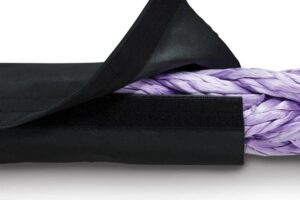
Combining the lightweight, abrasion resistant and non-water absorbing properties of HMPE fiber, Braided Chafe protection is a tightly braided tubular structure which can be freefloating or fitted onto the sling to offer the highest protection from cuts and abrasion that KWRS offers.
HMPE Narrow Woven
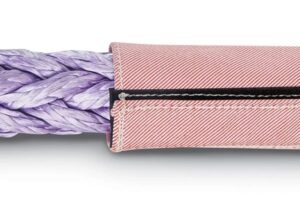
Combining the lightweight, abrasion resistant and non-water absorbing properties of HMPE fiber, Narrow Woven protection is a lightweight woven fabric structure which is easy to install and retrofit on existing slings, providing protection from cuts and abrasion.
Sidewinder
A cost-effective woven fabric material, Sidewinder is the most commonly used protection for abrasion. This protection is available as a permanent installation, or in a removable / replaceable form with a hook-and-loop closure.
Common Hitches for HMPE Slings
Vertical Pull
Vertical Pull
A method of rigging in which the load is attached to one end of the synthetic web sling, usually being attached by means of a hook or shackle, and the other end of the sling is attached to the lifting device. A tag line should be used to prevent load rotation.
WARNING: Any single sling hitch must never be used to transport a load that is not balanced.
Basket Hitch
Basket Hitch
A method of rigging in which the synthetic web sling is passed around the load and both ends are attached overhead.
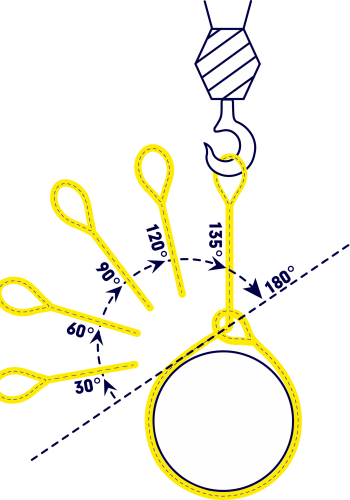
WARNING: Rated capacities are affected by the sling to load angle when used in multi-leg bridles or basket hitches. Sling angles of less than 30 degrees are not recommended.
Choker Hitch
Choker Hitch
| Angle of Choke Degree | Rated Capacity |
|---|---|
| Over 120 | 100% |
| 90–120 | 87% |
| 60–89 | 74% |
| 30–59 | 62% |
| 0–29 | 49% |
Double Wrapped Choker Hitch
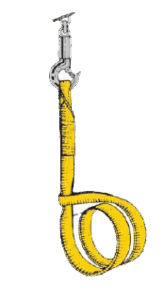
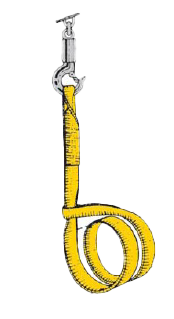
A method of rigging in which the web sling is passed around the load twice and then through itself, normally through the sling eye, and then attached to the lifting device.
WARNING: Any single sling hitch must never be used to transport a load that is not balanced.
Proper Hitching Methods for HMPE Slings
Single Leg Hitch
Single Leg Hitch
Single leg hitches such as the single leg vertical and the single choker hitch may not provide optimum control over the load. In these hitches only one synthetic web sling supports the load. In a single choker hitch, there is always a part of the synthetic web sling at the choke point not in contact with the bundle being lifted.
Double Wrapped Choker Hitch
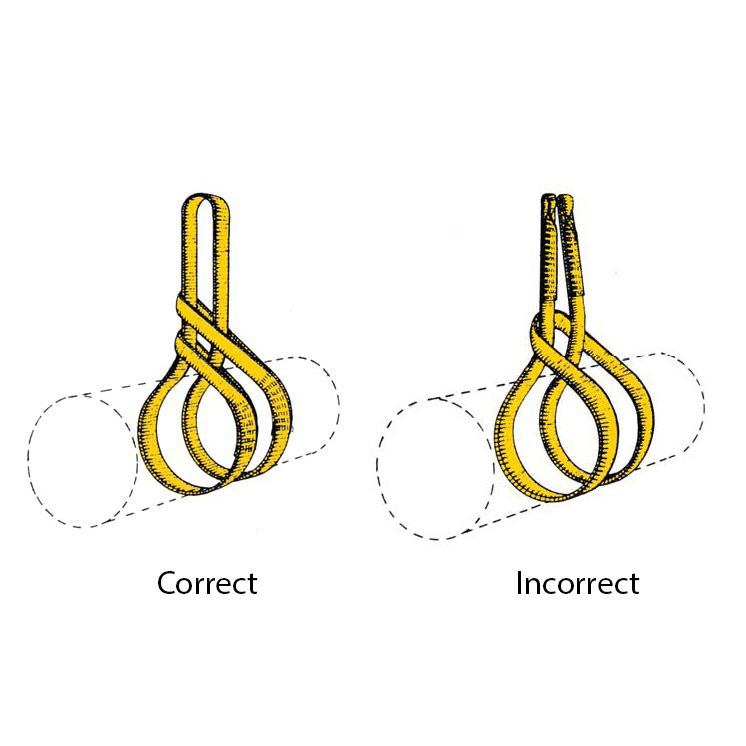
The double wrap choker hitch or the double wrap hitch provides full 360-degree contact with the load.
WARNING: When using a double-wrap hitch, avoid overlapping slings, as it can lead to uneven load distribution, sling damage, and compromised safety.
Double Choker Hitch
Double Choker Hitch
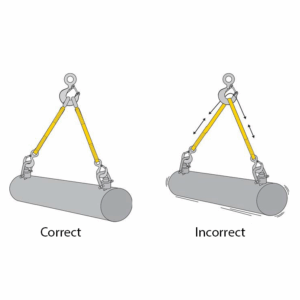
The double choker hitch appears to be preferred by many riggers because it is twice as strong as a single choker hitch in the same sling type. When this hitch is made in the right way, both legs will automatically equalize over the crane hook. However, when it is made wrong, there is usually no equalization and one of the legs will support most of the load
Basket Hitch
Basket Hitch
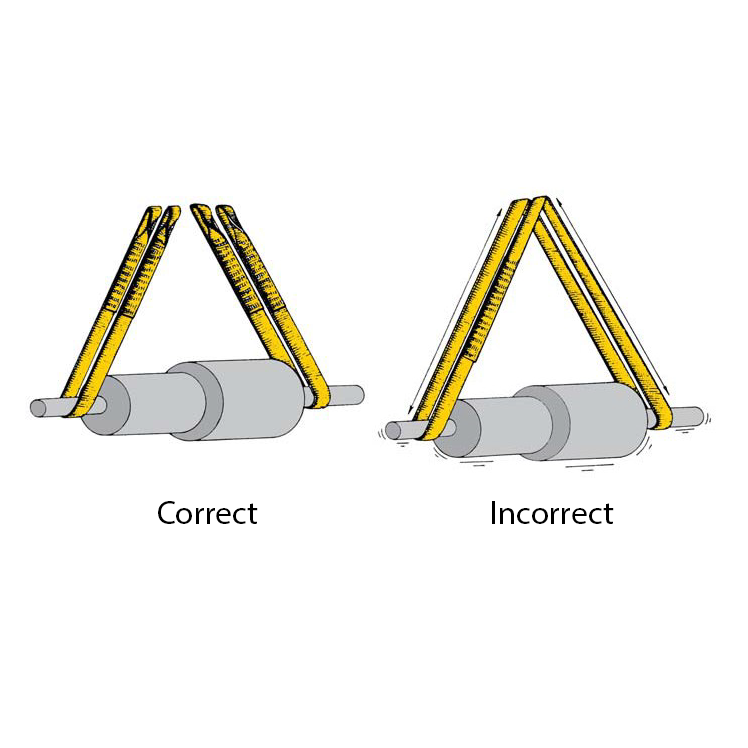
Basket hitches, whether single or double, may be used successfully in a variety of applications. However, they have inherent limitations.
WARNING: As sling angles decrease, the risk of slings skipping across the load or the load slipping out of the slings becomes greater, creating an unbalanced condition.
Turning Hitch
Turning Hitch
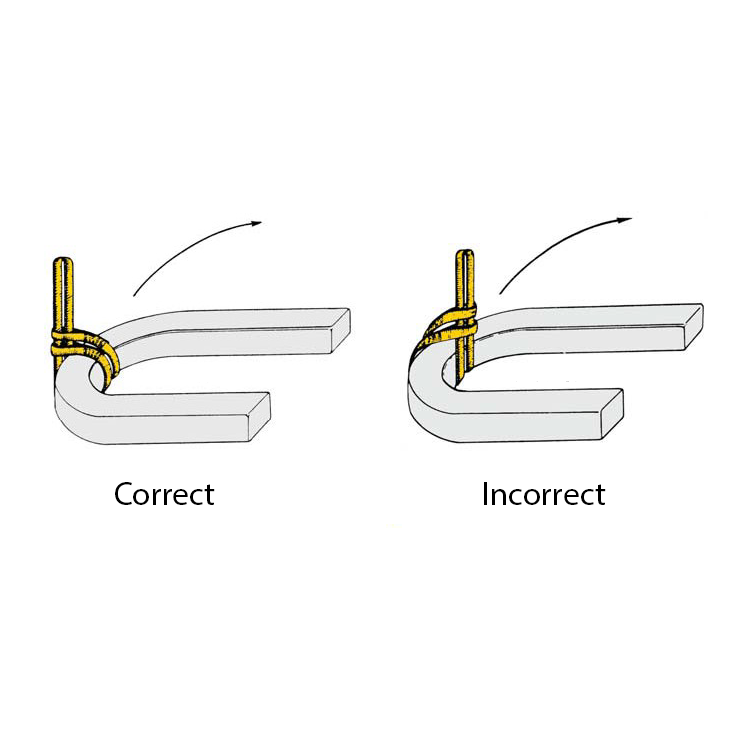
When turning a load, always use a choker hitch. If the turning hitch is made the wrong way, the turning action of the load will loosen the hitch. Note: A basket hitch should not be used for turning a load, causing it to slip.
WARNING: A basket hitch should not be used for turning a load
Two Ends Down Single Basket Hitch
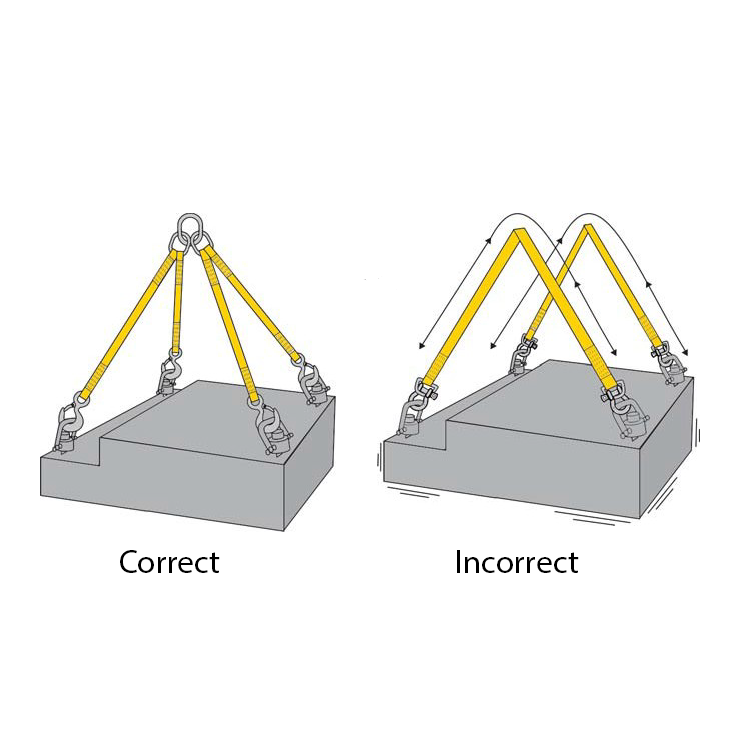
The following hitches can all be classified as “hook equalizing hitches.” Since the bite of the sling is on the hook, the sling is free to slip through the hook according to the distribution of weight on the various legs. There are dangers to be avoided in the use of these hitches.
Four Ends Down Single Basket Hitch
Rope Sling Configuration
Just as important as selecting the right fiber and construction, selecting the correct configuration will further enhance the performance of any sling. There are two primary configurations for fiber rope slings:
Eye and Eye Slings
When spliced into an eye and eye sling, HMPE will essentially act as a size-for-size
replacement for a traditional steel wire rope sling in terms of strength. Each end is
terminated using a KWRS approved splice which becomes locked in place after proof load testing.
Due to the splice length and free span requirements as shown in the drawing below, eye and eye slings have a minimum length that must be considered. The sling can be made only so short due to the splices. Refer to minimum sling length column in the sling rating charts.
- Minimum D:d ratio in the eyes is 1:1
- Minimum eye length must be 6x the bearing surface diameter or pin diameter to maintain the vertex angle below 300
- Rated capacity of eye and eye slings in a vertical pull include splice efficiencies
- When basketing eye and eye slings, the rated capacity will be affected when the basket point D:d ratio is less than 25:1
Endless Grommet Slings
Grommets are manufactured by splicing the ends of a rope together to form a continuous loop. Compared to eye and eye slings, they have increased strength with little to no increase in the chosen rope diameter due to two legs holding the load. Alternatively, the same load can be held with a smaller rope diameter due to the two legs holding the load.
The breaking strength of endless grommet slings is directly affected by the pin diameter on which they are mounted.
- Grommet sling rated capacity is directly related to the contact curvature on which it will
be used - Grommet sling ultimate strength is based on applying a configuration factor (CF) to the
single leg strength to which the rope is made
- Grommet sling rated capacity is directly related to the contact curvature on which it will
Proof Loading
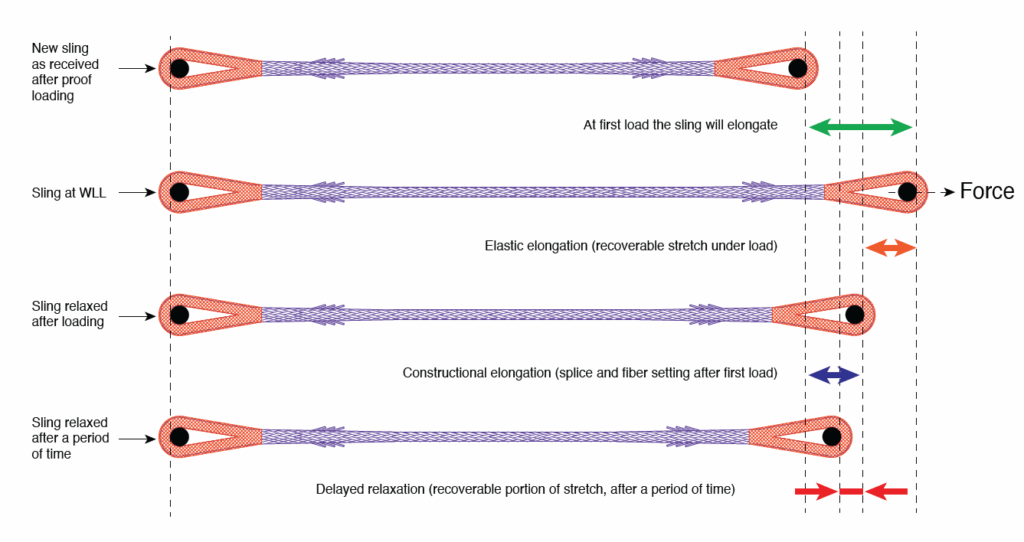
Proof-loading is a non-destructive process which subjects the completed sling assembly to a predetermined load, typically 40% of the MBL of the rope.
After fabrication, KWRS fiber rope slings will be subjected to preload or proof-load testing. Physical properties that change while load testing are:
- Diameter will decrease
- Length will increase
During the initial proof load testing, the rope will experience constructional elongation. The purpose of preloading is to remove constructional stretch and stabilize the elongation properties of the sling. During this process the rope will elongate approximately 5–6% and reduce in diameter.
It is at this time that the as-built, fabricated length of the sling is taken (i.e., after proof load testing).
Can’t find what you’re looking for?
Give us a call! We offer custom solutions and expert guidance to help ensure a safe and efficient lift.