
Round Slings
Polyester round slings are versatile and durable lifting solutions designed to handle loads safely and efficiently in a variety of applications. Made from high-strength polyester fibers encased in a seamless tubular sleeve, these slings offer exceptional performance, especially when lifting delicate or irregularly shaped loads.
Polyester round slings are versatile and durable lifting solutions designed to handle loads safely and efficiently in a variety of applications. Made from high-strength polyester fibers encased in a seamless tubular sleeve, these slings offer exceptional performance, especially when lifting delicate or irregularly shaped loads.
Key advantages of polyester round slings include:
- Flexibility and Lightweight Design: Easily adjustable to different load shapes, they reduce strain on riggers during setup and handling.
- Load Protection: The soft polyester material minimizes damage to the surface of the load, making them ideal for sensitive or finished items.
- Versatile Applications: Suitable for vertical, choker, and basket hitch configurations, these slings adapt to diverse lifting requirements.
- Long Service Life: The endless design allows rotation to distribute wear evenly, extending the sling’s lifespan.
Commonly used in industries such as construction, shipping, manufacturing, and warehousing, polyester round slings provide a balance of strength, safety, and versatility. Proper inspection and adherence to rated capacities ensure safe and effective lifting operations.
Length Tolerances for Round Slings
| Round Sling Capacity Range | Tolerance* |
|---|---|
| 30,000 lbs. or Less | ± (1” + 1% of sling length) |
| Higher than 30,000 lbs., up to 90,000 lbs. | ± (2.0” + 1% of sling length) |
| Higher than 90,000 lbs., up to 175,000 lbs. | ± (3.0” + 1% of sling length) |
| *For exact matching length slings, please contact us. |
Round Sling Features
- Max working temp: 194° F
- No loss of strength when wet
- Seamless with double jacket
- Resists most acids
- Lightweight – easy to use, handle and store
- Only 3% elongation
- Endless construction rotates wear points
- Color coded
- Lightweight, flexible, and easy to handle and rig
- Polyester round sling elongation at rated capacity is approximately 3%—less than that of comparable nylon or polyester web slings
- Wear points can be easily rotated to extend sling life
- Polyester round sling are easy to inspect
- Polyester round slings are less damaging on contacting load surfaced than metal type slings
- The exterior cover aids in protecting the load bearing core yarn
- Additional permanent or removable wear resistant coverings can be purchased for additional protection
Protecting Slings from Damage



Environmental Considerations
Environmental factors, such as an exposure to sunlight, dirt, or gritty-type matter and cyclical changes in temperature and humidity, can result in an accelerated deterioration of round slings. The rate of this deterioration will vary with the level of exposure to these conditions.
Temperature Limits – Do not expose round slings to sources of heat damage or weld splatter.
- Polyester round slings shall not be used in contact with objects or in environments at temperatures in excess of 194° F (90° C), or at temperatures below minus 40° F (-40° C).
- For short term, single exposure applications at temperatures elevated slightly higher than the above values, sling users may consult with the sling manufacturer and seek written approval to allow this practice.
Chemical Environment – Do not expose slings to damaging chemicals. Chemically active environments can affect the strength of round slings in varying degrees ranging from little to total degradation. The round sling manufacturer or a qualified person should be consulted before round slings are used in a chemically active environment. Each chemical application shall be evaluated, taking into consideration the following:
- Type of chemical, such as acid or alkalis
- Exposure conditions, i.e., liquid, vapor, mist
- Concentration
- Temperature
- Duration of exposure
Round slings incorporating aluminum fittings shall not be used where fumes, vapors, sprays, mists, or liquids of alkalis and/or acids are present, unless the compatibility of these material is verified.
Otherwise, severe injury or death can result from shock, burns, or electrocution. Consideration shall also be given to the effect of other environmental factors, including humidity, on the sling’s capability for this purpose.
Mechanical Considerations
Round slings in contact with edges, corners, or protrusions MUST ALWAYS be protected with materials of sufficient strength, thickness, and construction to prevent sling damage.
- Round slings should be protected from abrasive surfaces.
- Determine the weight of the load. Round slings shall not be loaded in excess of the rated capacity. Consideration shall be given to the sling angle, which affects rated capacity.
- Select round slings that have suitable characteristics for the type of load, hitch and environment.
- Round slings with fittings that are used in a choker hitch shall be of sufficient length to ensure that the choking action is on the round sling and never on the fitting or sling tag.
- The openings in fittings shall be the proper shape and size to ensure that the fittings will seat properly on the round sling, crane hook, or other attachments.
- Round slings should not be dragged on the floor or over an abrasive surface.
- A half twist (up to 180° ) may be applied to any round sling to facilitate its attachment. However, round slings must not be twisted further or be tied into knots to shorten their length or be joined to another round sling by knotting them together. Round slings shall be shortened, lengthened, or adjusted only by methods approved by the manufacturer.
- Round slings should not be pulled from under loads when the load is resting on the round sling. Place blocks under load prior to setting down the load to allow removal of the sling, if applicable.
- Round slings shall not be used to pull against stuck, snagged, or restrained objects.
- Do not drop round slings equipped with metal fittings.
- Round slings that are damaged shall not be used.
- Round slings shall be hitched in a manner providing control of the load. Round slings used in a basket hitch shall have the load balanced to prevent slippage.
- Shock loading shall be avoided.
- Load applied to a hook shall be centered in the bowl of the hook to prevent point loading.
- During use, personnel shall be alert for possible snagging of the load or round sling.
- When using a basket hitch, round sling legs (branches) shall contain or support the load from the sides above the center of gravity.
Tags and labels should be kept away from the load, hook, and point of choke. - Round slings should not be constricted or bunched between the ears of a clevis or shackle or in a hook. When a round sling is used with a shackle, it is recommended that it be used (rigged) in the bow of the shackle. When this is not possible, protect the sling connection areas from damage.
- For lifts using multiple slings, or multiple-leg bridle slings, on non-symmetrical loads, an analysis by a qualified person should be performed to prevent overloading of any leg.
- Do not use hooks, shackles, or other hardware that have edges or surfaces that could damage the sling.
- Do not run or drive over slings with a vehicle or other equipment.
Protection Considerations
Round slings can be damaged, abraded or cut as tension and compression between the sling, the connection points and the load develops. Surfaces in contact with the sling do not have to be very abrasive or have “razor” sharp edges in order to create the conditions for sling failure. Therefore, web slings must ALWAYS be protected to prevent sling damage.
There are a variety of ways to protect slings from damage. A qualified person might select and use appropriately engineered protectors or softeners—commercially available products such as:
- Sleeves
- Wear pads
- Edge wraps
- Body wraps
- Corner protectors
- Other purpose-built devices
A qualified person must ensure that the protection method chosen is appropriate for the specific types of damage the sling may encounter. For example, some protection offers abrasion resistance but provides little to no defense against cuts.
Several “test” lifts, done in a non-consequence setting may be necessary to determine the suitability of the protection device(s). After each “test” lift, the protection device(s) and the sling(s) need to be inspected for damage and suitability. You should keep in mind that no protection is “cut proof” and you should always operate within the specified limits of the sling and its accessories.
Sling Storage and Maintenance
- Round slings should be stored in a cool, dry, and dark place to prevent loss of strength when not in use.
- Round slings shall not be stored in chemically active areas.
- There shall be no repairs of load bearing fibers.
- Repairs to the protective covers shall be done only by the original manufacturer or their appointed agent.
- When slings are repaired by someone other than the original manufacturer, the sling should be tagged to identify the repair agent.
- Only round slings which can be identified from the information on the identification tag shall be repaired.
- All repaired round slings shall be proof tested to a minimum of 2 times the rated capacity before being put back into service.
- Certification of proof test should be provided.
⚠️ WARNING ⚠️
Failure to follow the care, use, and inspection instructions of a sling could result in severe personal injury or death.
Do NOT exceed rated capacities.
Inspection
Slings must be regularly and properly inspected. Even seemingly “minor” damage to a web sling can significantly reduce its capacity to hold or lift objects and increases the chance that the sling will fail during use. If you are not sure whether a sling is damaged, DO NOT USE IT.
How to Inspect Slings
To detect possible damage, you should perform a visual inspection of the entire sling, and also feel along its entire length, as some damage may be felt more than seen.
What to Do If You Identify Damage In a Sling
If you identify ANY of these types of damage in a sling, remove it from service immediately even if the damage you feel or see is not extensive. Slings that are removed from service must be destroyed and rendered completely unusable.
Frequency of Inspection – ASME B30.9-5.9
A 3 stage procedure is recommended to help ensure that round slings are inspected with appropriate frequency.
- Initial Inspection – Slings must be inspected by a designated person as soon as they are recieved. This ensures that the correct round sling has been received, is undamaged, and meets the requirements for its intended use.
- Frequent Inspection – When round slings are being used where they are not being exposed to any severe service conditions, the frequency of this sling inspection interval may be reduced to once each day or shift, done prior to sling use. A qualified person must be monitoring the application to verify that the slings are not being exposed to any conditions that could cause a rapid rate of sling degradation during the work shift.
- Periodic Inspection – Every sling must be inspected “periodically” by a qualified and designated person. The frequency of periodic inspections is based on the sling’s actual or expected frequency of use, severity of service conditions, and the nature of the work performed with the sling.
Removal Criteria
Possible Defects – ASME B30.9-5.9
A sling shall be removed from service if any defects such as the following are visible:
- A sling shall be removed from service if any defects such as the following are visible:
- Holes, tears, cuts, embedded particles, excessive abrasive wear or snags that expose the core fibers of the round sling
- If round sling identification tag is missing or not readable
- If round sling has been tied into one or more knots or has been joined by knotting
- Melting, charring or weld spatter on any part of the round sling
- Acid or alkali burns of the round sling
- Broken or worn stitching in the cover that exposes the core fibers
- Distortion, excessive pitting, corrosion or other damage to fitting(s)
- Any evidence of a broken core yarn(s) present in the form of a substantial reduction of core yarn within any area of the round sling and/or by a substantial accumulation of core yarn bundle within any section of the round sling
- Any conditions that cause doubt as to the strength of the round sling
Proper Hitching Methods for Web Slings
Vertical Hitch
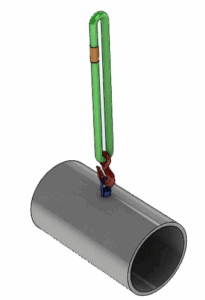
Vertical Hitch
A method of rigging in which the load is attached to one end of the sling, such as by means of a hook or shackle, and the other end of the sling is attached to the lifting device. This hitch is sometimes also called a straight-line hitch.
Choker Hitch
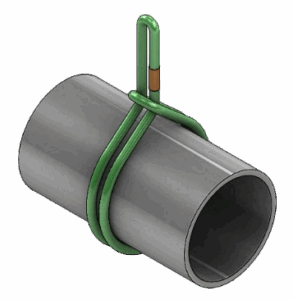
Choker Hitch
A method of rigging in which the sling is passed around the load and then through itself and then attached to the lifting device.
Double Wrapped Choker Hitch

Double Wrapped Choker Hitch
A method of rigging in which the sling is passed around the load twice and then through itself and then attached to the lifting device. The double wrap hitch or the double wrap choker hitch provides full 360 degree contact with the load.
WARNING:When using a double-wrap hitch, avoid overlapping slings, as it can lead to uneven load distribution, sling damage, and compromised safety.
Basket Hitch

Basket Hitch
A method of rigging in which the sling is passed around the load and both ends are attached to the lifting device.
Double Wrapped Basket Hitch
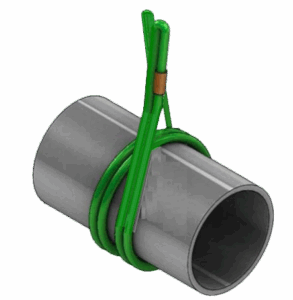
Turning Hitch
A method of rigging similar to the basket hitch except that the sling is passed around the load twice.
WARNING:When using a double-wrap hitch, avoid overlapping slings, as it can lead to uneven load distribution, sling damage, and compromised safety.
Bridle (Multi-leg) Hitch

Two Ends Down Single Basket Hitch
A method of rigging as a 2-leg bridle, in which the load is attached to the legs of a bridle assembly. 2-, 3- and 4-leg slings are commonly used types of bridle slings.
Selection of Proper Connection Hardware
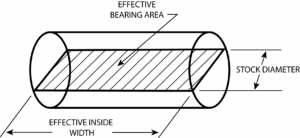
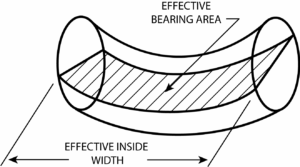
Effective Contact Width between the Sling and Connection Hardware
Straight Bearing Surface
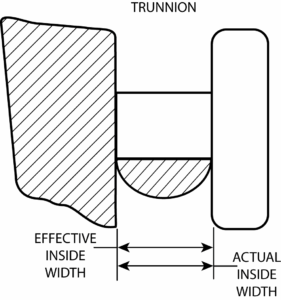
Curved Bearing Surface
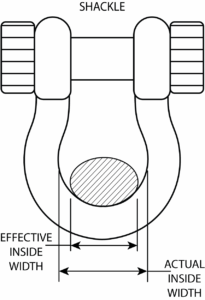
NOTE: Round sling strength is affected by the size of the connection hardware. For special applications wherein a retained design factor of 5 is required to be maintained, contact the sling manufacturer, as a capacity reduction of 20% may be appropriate in order to satisfy this criteria.
Can’t find what you’re looking for?
Let us help you! We offer custom solutions and expert guidance to help ensure a safe and efficient lift.